




CUIT for Foreigners in Argentina: Complete Guide 2026
Professional Guide to Argentina’s Tax Identification System, International Asset Planning, and Its Connection with Argentine Immigration and Residency Structures
Anibal Falivene
5/10/20266 min read
1.Introduction
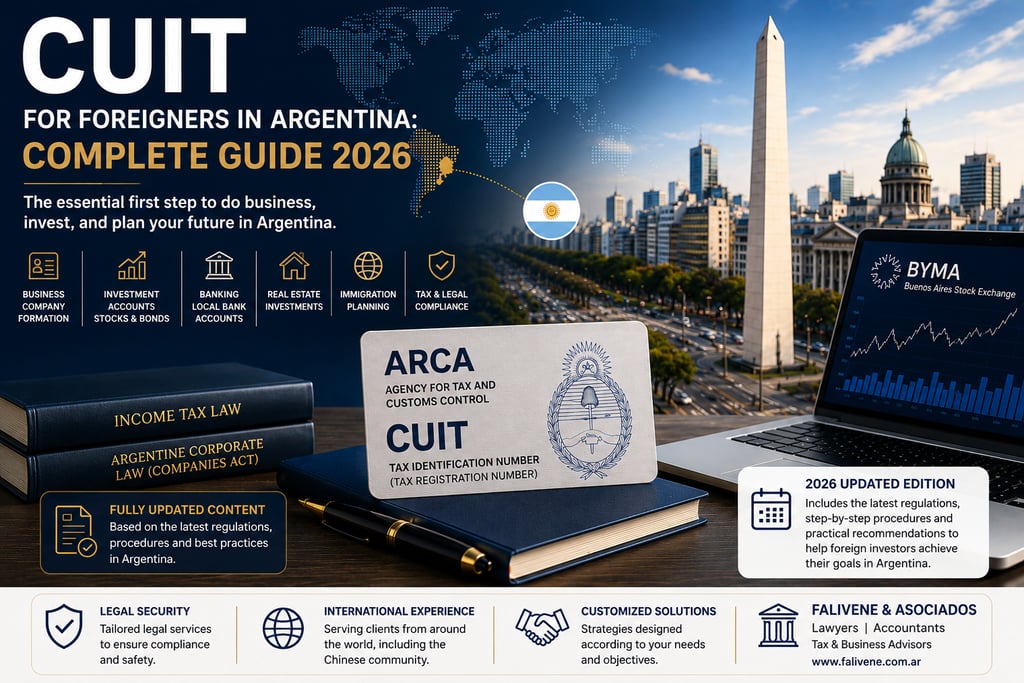
In Argentina, obtaining a CUIT (Clave Única de Identificación Tributaria – Unique Tax Identification Code) is one of the most important steps for any foreign individual seeking to carry out commercial, financial, or investment activities in a formal and sustainable manner.
Although many people assume that the CUIT is merely a tax number, in practice it functions as the investor’s true “economic identity” within the Argentine legal and financial system.
Without a CUIT, many relevant commercial and financial operations simply cannot be performed.
Furthermore, from a migration and wealth-planning perspective, maintaining real economic activity in Argentina may become a highly favorable factor for future residency or citizenship applications — including the new Argentine citizenship-by-investment framework established under Decree 524/2025 — especially when there is consistency between the investor’s professional profile and the activities developed locally.
2. Obtaining a CUIT Does Not Automatically Create Argentine Tax Residency
One of the most common misunderstandings among foreign investors is the belief that obtaining a CUIT automatically converts an individual into an Argentine tax resident. Legally, this is incorrect.
Pursuant to Article 119 of the Argentine Income Tax Law (Law 20,628, 2019 consolidated text), foreign individuals generally acquire Argentine tax residency when:
they obtain permanent residency under Argentine immigration law; or
they remain in Argentina for twelve (12) months under temporary immigration authorizations, with certain temporary absences still considered part of continuous residence under applicable regulations.
The law also establishes exceptions for individuals whose presence in Argentina is connected to:
temporary business activities;
academic programs;
medical treatment;
scientific activities;
or other temporary purposes,
thereby preventing automatic conversion into Argentine tax residents.
Additionally, Double Taxation Treaties signed by Argentina must also be considered, including the Argentina–China Double Taxation Agreement in force since 2021, which contains tie-breaker rules designed to resolve conflicts of tax residency between jurisdictions.
As long as those conditions are not met, a foreign individual may perfectly hold a CUIT exclusively as an economic and tax identification tool for formal operations in Argentina, without automatically becoming subject to Argentine taxation on foreign-source income.
In practical terms, the CUIT currently functions as an indispensable economic and digital identity required to interact with Argentina’s financial, commercial, and regulatory systems.
3. CUIT for Non-Resident Foreigners
Under current practice, ARCA (Agencia de Recaudación y Control Aduanero), the agency created by Decree 953/2024 replacing AFIP, is granting CUIT registrations to non-resident foreigners.
However, the procedure is not always simple or fully automated.
In most cases, foreign individuals or foreign companies will require:
local representation through an attorney-in-fact or administrator domiciled in Argentina;
apostilled documentation under the Hague Convention;
certified translations performed by licensed public translators;
proof of tax domicile;
and compliance with additional regulatory requirements depending on the activity involved.
Administrative delays may also arise, particularly in cases involving:
foreign companies registered under Article 123 of the Argentine General Companies Law;
complex international structures;
regulated financial activities;
or banking and securities market onboarding procedures.
For this reason, although many procedures may be partially organized remotely, in practice it is usually essential to work alongside lawyers, accountants, and local representatives experienced in handling international clients.
4. CUIT as the Gateway to the Argentine Economic System
Today, the CUIT is indispensable for multiple economic and financial activities.
In practical terms, it operates as the formal gateway into Argentina’s economic system.
Without a CUIT, it is generally impossible to:
incorporate local companies;
open bank accounts;
open investment or brokerage accounts;
purchase Argentine stocks or bonds;
perform real estate investments;
issue invoices;
register tax activities;
operate e-commerce businesses;
import or export goods;
conduct filings before ARCA, IGJ, CNV, or the Argentine Central Bank (BCRA);
or fully interact with Argentina’s financial system.
As a result, even investors who are not yet planning to relocate to Argentina often begin by obtaining a CUIT and structuring their local economic and asset presence.
5. Incorporating a Commercial Company in Argentina
The incorporation of a local company — particularly an SAS (Simplified Stock Corporation) or SRL (Limited Liability Company) — has become one of the most commonly used structures for foreign entrepreneurs seeking to begin operations in Argentina without permanently residing in the country.
Through an Argentine company, it is possible to:
operate e-commerce businesses;
open local Mercado Libre stores;
import or export products;
conduct hospitality and restaurant activities;
invest in urban or rural real estate;
provide professional services;
participate in agricultural, technological, mining, or energy projects.
However, for the company to operate properly, obtaining a CUIT is essential.
It is also important to distinguish clearly between:
the CUIT assigned to the company itself; and
the personal CUIT of shareholders, representatives, or directors.
In many cases, both will be required to complete banking, tax, and regulatory registrations correctly.
In practice, many corporate delays in Argentina are not caused by the company incorporation itself, but rather by the process of obtaining CUIT registrations for foreign shareholders, directors, or legal representatives.
Properly anticipating these timelines often prevents future obstacles involving bank account openings, regulatory registrations, and commercial operations.
6. Opening an Investment Account to Purchase Argentine Stocks and Bonds
Another increasingly common strategy among international investors consists of opening an Argentine investment account to trade:
Argentine publicly traded shares listed on BYMA;
sovereign bonds;
corporate debt securities;
mutual investment funds;
dollar-linked instruments;
CEDEARs;
and other assets connected to the Argentine capital markets.
Argentina continues to offer certain financial instruments with dollar-denominated returns significantly higher than international averages.
However, those returns are inseparably connected to:
Argentine sovereign risk;
macroeconomic volatility;
and local regulatory complexity.
For that reason, any investment must be evaluated individually considering:
investment horizon;
risk tolerance;
global asset diversification;
international tax position;
and the investor’s migration or wealth-planning objectives.
To formally open an Argentine investment account, most brokers and ALyCs (Clearing and Settlement Agents authorized by the CNV) will generally require:
a valid Argentine CUIT;
updated asset documentation;
documented proof of source of funds;
international tax information (CRS/FATCA where applicable);
and compliance with anti-money laundering and counter-terrorism financing regulations.
Depending on the financial institution, certain onboarding procedures may be completed partially remotely, while others may require:
specific powers of attorney;
biometric verification;
compliance interviews;
or even physical presence.
Additionally, it must be noted that Argentine Central Bank (BCRA) foreign exchange regulations and policies affecting international transfers and foreign currency operations may change frequently, impacting banking and financial procedures.
7. A Strategic Tool for Chinese Investors
For Chinese nationals, these structures may be particularly useful from an international wealth-planning and cross-border asset diversification perspective.
Currently, many Chinese investors utilize the annual foreign exchange quota authorized by SAFE (State Administration of Foreign Exchange) — approximately USD 50,000 per individual per year — to gradually build assets outside mainland China within the applicable legal framework.
In this context, opening an investment account in Argentina may help investors:
gradually accumulate international assets;
develop offshore financial history;
create verifiable wealth records;
and prepare in advance for future residency-by-income, investor residency, or citizenship-by-investment applications.
From a practical standpoint, many investors find it more efficient to:
first structure international assets and financial operations, and only afterwards formally initiate the immigration process.
The documentary consistency developed during this preparatory stage may substantially strengthen future migration and wealth-planning applications.
Naturally, this type of planning must always comply with:
applicable foreign exchange regulations;
international banking rules;
tax obligations in each jurisdiction;
AML/KYC policies;
and the compliance standards of all institutions involved.
8. Activities That May Be Partially Organized Remotely
One important advantage of the Argentine system is that many of these activities may be partially organized remotely, particularly when the investor works alongside coordinated lawyers, accountants, and local representatives.
However, it is equally important to maintain realistic expectations.
Argentina continues to present:
significant administrative bureaucracy;
frequent regulatory changes;
structural foreign exchange complexity;
historically high inflation;
and banking procedures that may vary substantially depending on the institution involved.
Therefore, although it is currently possible to advance remotely in matters such as:
company incorporation;
CUIT registration;
wealth structuring;
investment preparation;
and certain financial onboarding procedures,
many cases will still require:
intensive document coordination;
specific powers of attorney;
additional compliance validations;
or physical presence during critical stages.
9. A Favorable Background for Future Immigration Applications
From an immigration standpoint, Argentine authorities generally place greater value on applicants capable of demonstrating:
real and verifiable economic activity;
genuine and traceable investments;
coherent business experience;
sustained tax compliance;
and stable ties with Argentina.
For that reason, establishing local companies or formal investment structures may not only serve commercial or wealth purposes, but may also become strategic tools within future Argentine residency or citizenship-by-investment planning.
In many cases, the truly relevant factor is not merely the amount invested, but rather the overall credibility of the project and the consistency between the investor’s professional trajectory and the activities carried out in Argentina.
Accordingly, beginning asset, corporate, and tax structuring at an early stage often creates decisive advantages once a formal immigration application is eventually initiated.
Disclaimer
The information contained in this article is provided exclusively for informational and educational purposes and does not constitute legal, tax, financial, or investment advice. Argentine regulations — particularly in tax, foreign exchange, banking, corporate, and immigration matters — are highly complex and subject to frequent changes.
The success of the operations described depends on an individualized analysis of each specific case.
Obtaining a CUIT, incorporating companies, or opening investment accounts does not by itself guarantee approval of residency or citizenship applications, which remain subject to the exclusive evaluation of the competent authorities under applicable law.
Falivene & Asociados
We advise foreign investors and entrepreneurs regarding:
Argentine CUIT registrations;
company incorporation (SAS, SRL);
bank and investment account openings;
international wealth planning;
and comprehensive immigration planning.
We provide specialized assistance for international clients and the Chinese-speaking community.
📍 Offices: Buenos Aires, Argentina
📱 WhatsApp / Telegram: +54 911 3232 8888
💬 WeChat: AFLAWYER
✉️ legal@falivene.com.ar
🌐 www.falivene.com.ar
🌐 www.lushi.com.ar
🌐 www.cbi.lawyer
🌐 阿根廷投资入籍.cn
Legal Advice
Protecting investors in stocks, bonds, cryptocurrencies, and other assets.
Attorney Aníbal Falivene
C.P.A.C.F. Registration: T. 71, F. 132
25 Years of Experience
I want to be contacted
Online verification:
Public Bar Association of the Federal Capital (Buenos Aires, AR)